
Put a metronome in front of a guitarist, then put a full backing track in front of the same guitarist a week later, and the two sessions barely resemble each other. One is quiet, exposed, and dependent entirely on internal pulse. The other is full, forgiving, and immediately fun. Neither approach is wrong. They build different reflexes, and most instrumentalists never stop to ask which reflex the moment actually calls for.
That is the real question hiding behind "with an accompaniment or without one": not which method wins in the abstract, but what each one trains, and what each one quietly lets you skip. For a beginner learning to hold a groove, an accompaniment is a lifeline. For a jazz musician trying to build a personal harmonic language, that same accompaniment can become a crutch without anyone noticing. This piece looks at both sides honestly: what backing tracks are genuinely great at, where solitary rehearsal still wins, how the trade-off plays out across styles, and a workable routine that uses both.
What a Backing Track Actually Gives You
The single biggest benefit of playing along with a full instrumental mix is context. A scale worked in isolation is an exercise. That same scale played over an actual chord progression, with bass and drums pushing the groove underneath it, becomes music. Backing tracks force you to lock your timing to something external, react to changes as they happen, and hear how a line actually sits against a full mix instead of against silence.
For guitarists and bassists especially, this matters. Rehearsing solo, a guitarist can drift in tempo for bars without noticing. Add an accompaniment, and any drift becomes obvious immediately, which is exactly the kind of feedback that sharpens rhythm fast. A pre-recorded rhythm section also builds performing confidence: rehearsing against a full ensemble sound, even a recorded one, makes the jump to a live gig or a small pro set feel far less exposed the first time you actually do it.
There is a practical side too. Not every instrumentalist has a group to call on a Tuesday night. Playback gives a lone player rhythm section support on demand, at whatever hour actually works, for as long as the session needs. That access is a genuine structural change in how a musician learns today, not just a convenience.

What Rehearsing Alone Still Teaches That Playback Can't
Here is the part backing track marketing tends to skip. When you sync up with an accompaniment, the pulse is already being kept for you. The harmonic rhythm, the sense of where beat one falls: all of it is handled by the mix. That is exactly why leaning on playback for every single session can quietly stall the growth of internal time feel, the ability to hold a genuine pulse in your own head with no outside help.
Writers who cover jazz education have flagged this for years: soloing over the same accompaniment again and again tends to reinforce whatever a player already does well, since the backing never asks anything new of them. You can float over the changes because the changes are always right there under you, and you can float over the tempo because it is always explicit in the mix. Working scales, arpeggios, or a tune with nothing but a metronome click, or with no click at all, forces you to generate the pulse and the harmonic movement internally. That is a materially different kind of work, and it is what builds the reflexes an instrumentalist actually leans on the moment an accompaniment, or an actual drummer, does something unexpected.
Research on this is more nuanced than either camp likes to admit. A study on novice drummers found no meaningful difference in accuracy between musicians who learned a pattern by themselves versus with a partner, suggesting that for raw technical repetition, solitary and ensemble rehearsal can land in the same place. What differs is not always accuracy, but the listening and adjusting skills that only come from playing with something that can genuinely surprise you, whether that is another player or, to a lesser extent, a recording with some give built into it.
Jazz, Improvisation, and the Backing Track Question
Jazz is where this debate gets sharpest, because the whole point of improvisation is building a personal musical language on the spot, not repeating rehearsed lines over familiar changes. Play-along records have been part of jazz education since 1967, when Jamey Aebersold released the first volume in what became a series of more than 130 records selling over five million copies worldwide, alongside decades of Summer Jazz Workshops at the University of Louisville running since 1977. That history matters: it proves the format works as a teaching tool, not as a replacement for the harder skills the genre demands.
The concern raised by educators in this idiom is specific. Working a standard, a blues, or a set of ii-V-I changes over the same rhythm section every time can turn into repeating the same vocabulary on the same chords, since the accompaniment never pushes back, never sits behind the beat, never leaves space the way an actual bass player might. A student can develop a comfortable way to get by on a tricky bridge without ever fixing the weak spot. There is a genuine skill most fixed audio cannot teach at all: reacting to another player's phrasing, trading fours, or following a rhythm section that pulls the tempo around on purpose. None of that lives inside a fixed mix.
None of this means backing tracks have no place in this style of rehearsal. They remain one of the fastest ways to internalize the character of a chord progression, to transcribe a favorite solo and then try that same vocabulary over the same changes, or to learn a piece's form before bringing it to an actual ensemble. The healthiest approach treats playback as a partner for specific goals, not as the default setting for every session.
A Routine That Uses Both
A simple structure keeps the benefits of both approaches without letting either one dominate:
- Click-only days. Pick one piece or one set of changes and run it with nothing but a metronome, or no click at all. This is where internal pulse and harmonic hearing actually get built.
- Playback days. Take the same material and run it against a full instrumental mix. Notice what changes: does the pulse feel different, does a line that worked alone suddenly seem rushed against an actual rhythm section?
- Recording yourself on both. A short clip of each session, even from a phone, tells you more in two minutes than an hour of guessing. Listen back for where the pulse actually sat.
- Transcribe, then apply. Pick a short phrase you love, figure it out by ear or by reading it off a lead sheet, then try that vocabulary yourself over an accompaniment. This is one example of turning a passive listening habit into an active tool.
- Rotate styles. Don't stay in one groove. A blues, a bossa, a straight-ahead swing piece, and a rock groove each ask different things of your ear and your sense of pulse.
None of this needs hours of downtime every day. Fifteen focused minutes with a click, followed by fifteen more against a full mix, will do more for a working instrumentalist's growth than an hour of unfocused noodling with playback running in the background.
Two Misconceptions Worth Retiring
The first misconception is that playback is a shortcut, something a serious instrumentalist eventually graduates away from. In truth it is a tool suited to specific goals: internalizing a new chord progression, rehearsing for an upcoming gig, or building confidence before a first jam with strangers. The second misconception runs the other way, that unaccompanied practice is old-fashioned now that full-band accompaniment fits on a phone. Unaccompanied practice is still the fastest route to a dependable inner pulse and a personal harmonic vocabulary, the very things a fixed accompaniment cannot supply on its own.
Both misconceptions come from treating this as a single binary choice rather than two tools with different jobs. A beginner who only ever rehearses unaccompanied risks getting discouraged before the fun sets in, since silence offers little reward for early effort. An instrumentalist who never steps away from playback risks plateauing without noticing, since every session can sound competent even when nothing underneath the surface is actually improving. Retiring both myths starts with naming what a given session is actually for before pressing play.
What This Looks Like Across Instruments and Voices
Guitarists and bassists tend to notice the difference first, since both instruments carry so much of a group's rhythmic identity. A guitar part that sounds fine alone can suddenly expose a weak strum pattern the moment a genuine drum groove sits underneath it. Singers get a related benefit: a steady instrumental reference helps a vocalist land pitch and phrasing consistently, though the same singer should still sing a cappella often enough to keep their own sense of pitch and pulse sharp rather than borrowed from the mix.
Pro players and working weekend instrumentalists alike tend to land on the same answer: use playback to rehearse for the situation you are about to walk into, whether that is a gig, a jam, or a session, and use silence or a bare click to fix the fundamentals playback lets you coast past. Neither camp needs to win the argument. The two simply answer different questions.

Quick Answers to Common Questions
Do you need to read music or use MIDI files to get value from a backing track?
No. Plenty of guitar and bass players never learn to read a single note and still get real value from playing along with a track, since the ear does most of the work. MIDI backing tracks exist too, and they are worth trying if you want to edit the arrangement of a tune yourself, but a standard audio backing track works just as well for most practice goals. Jamzone is here for that.
I don't have hours of free time every day. Is a short practice session still worth it?
Yes, and this is one of the biggest misconceptions out there. Fifteen focused minutes with a backing track, done well, beats an hour of unfocused noodling. Consistency matters more than raw hours, and a short daily session with a track will build real progress faster than one long weekend session.
Do backing tracks help with live performance nerves?
They help a great deal. Rehearsing a full band sound before a live performance takes the surprise out of the moment, and most working musicians will say a pro-level backing track is the closest thing to a real band rehearsal without booking one. Playing along with a track that mimics a live set builds the same performing confidence a real gig demands.
Can playing along with a backing track help me write my own songs?
Yes. Practicing a song's structure against a full backing track teaches you how a verse, a chorus, and a bridge actually sit against a real rhythm section, a skill that carries directly into writing your own songs and tunes later.
Should I post my practice sessions or transcriptions online?
It's optional, but many musicians find real support and useful feedback from posts, short clips, or transcriptions they share for other players to react to. That kind of content also adds a bit of accountability to the routine, which helps some musicians stick with practice longer.
What should I look for in a good jazz standard backing track?
Look for a real rhythm section playing the standard changes at a reasonable tempo, with enough space in the mix to hear the bass clearly. A well-chosen blues or standard in a comfortable key is a great place to start a session before moving on to faster material, and there are plenty of good places to look for one before committing.
Does practicing with a track change how a band sounds together, not just solo playing?
Yes. A guitarist or bassist who has internalized a groove against a backing track tends to lock in faster once a real band starts playing, since the ear and the internal sense of time have already done the work once, well before the first rehearsal.
Where Jamzone Fits In
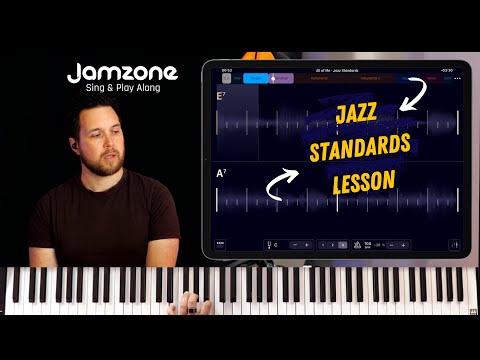
For the playback half of that routine, the tool matters. Jamzone gives musicians a catalog recorded by genuine professional players, with chords and lyrics on screen, full tempo and pitch control, and the ability to mute individual instruments so a guitarist, bassist, or singer can isolate exactly the part they need to hear, or the part they need to disappear. That control turns a generic accompaniment into a genuinely useful tool: slow a tricky bridge down without shifting the key, mute the guitar to force yourself to comp, or loop eight bars until a transition finally locks in.
It also solves the access problem from earlier: a full group, on call, for a session at any hour, whether that means a quick run-through before a shift or a late-night rehearsal before a gig. DOWNLOAD Jamzone and try it against a track you already know well, then again against something new, to feel the difference for yourself.
What This Changes for a Working Instrumentalist's Practice Room
The honest answer is that neither approach wins outright, and treating this as a single choice is where most instrumentalists go wrong. Playback builds context, timing feedback, and performing confidence fast. Silence, or a bare click, builds the internal pulse and harmonic reflexes that playback can quietly let you skip. The players who improve fastest tend to be the ones who use both on purpose, not the ones who pick a side and defend it. Next time you sit down to rehearse, decide first which reflex the session is actually for, then choose the tool that trains it.


